The Small Print, Made Simple: What Your Medicine Label Is Really Telling You

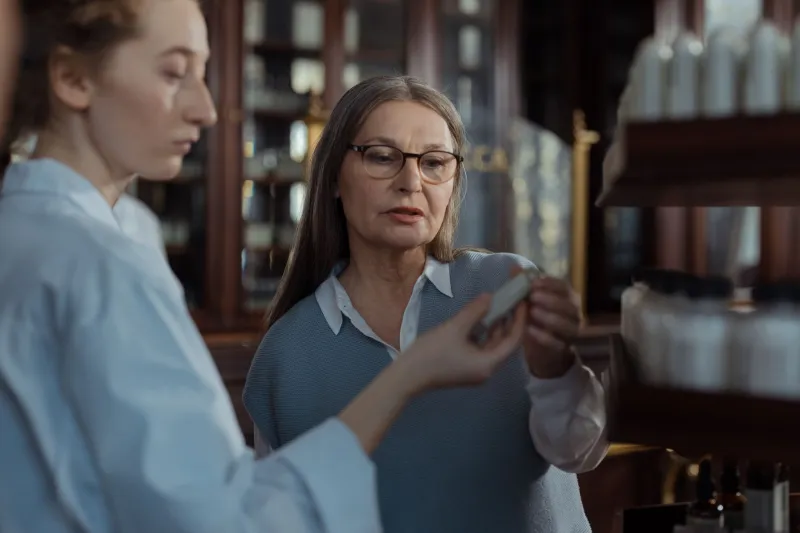
Photo: pharmacist explaining medicine label to patient at UK pharmacy counter, via d92mrp7hetgfk.cloudfront.net
Medicine labels are supposed to make things clearer, not send you hunting for a dictionary. Yet a few familiar phrases turn up on packet after packet, and they can mean slightly different things depending on the medicine. The good news is that most of the small print is there to protect you, not confuse you. Think of it as a set of practical hints rather than a test.
Why the label sounds so formal
Pharmacists and manufacturers have to be precise. A label cannot say 'take a couple when you feel rough' because that leaves too much to chance. So you get instructions such as 'take one tablet twice daily' or 'do not take with antacids'. They are written for safety, but they are not always written for real life. That is where a conversation at the counter can help. If you are ever unsure, bring the box or the prescription slip to us and we will talk it through.
'Take with food' does not always mean a roast dinner
For many medicines, 'with food' means exactly what it says: take it around mealtime, or with a small snack if a full meal is not practical. Some medicines are gentler on the stomach that way. Others are absorbed better when there is food in your system. A few simply work better if you do not take them on a completely empty stomach.
There is a difference between 'with food', 'after food' and 'on an empty stomach'. If the label says 'on an empty stomach', it usually means about an hour before food or a couple of hours after. If it says 'with or just after food', a bowl of porridge or a slice of toast is fine. If you are not sure whether a glass of milk counts as food, ask us. It is a common question and a sensible one.
'Four times daily' is not a midnight alarm call
Unless you have been told otherwise, 'four times daily' usually means spread across your waking day. It does not normally mean setting an alarm for every six hours through the night. For example, breakfast, lunch, teatime and bedtime can work well for many people. Some medicines do need even spacing, though, so check the leaflet or ask us if the timing matters.
This is also where routines help. Keep the medicine somewhere you will see it at the same points in the day, but safely out of reach of children and pets. A simple phone reminder or a tick chart can be surprisingly effective. If you are juggling several medicines, ask us about a weekly dosette box or a review. It is better to sort out a muddle now than to guess later.
'Avoid alcohol' can mean different things
Some medicines interact badly with alcohol. Others may make you drowsy, and alcohol can make that worse. A few are simply better avoided while you are recovering. The label may say 'avoid alcohol' as a broad warning, but the detail in the patient leaflet is worth a look. If you are planning a quiet drink and want to know whether it is safe with your medicine, ask us. Bring the name and dose, or the box itself, and we can give you practical advice.
Never stop a medicine just because you want a drink without checking first. Some medicines should not be stopped suddenly, and that includes certain tablets for blood pressure, mood or epilepsy.
'Finish the course' is not a rule for every medicine
You will often see 'finish the course' on antibiotics. That is because stopping early can let bacteria hang around and become harder to treat. But not every medicine works that way. Some tablets are taken only when needed, and some are meant to be continued long term. If you are unsure, read the label and the leaflet, then ask us. Do not save leftover antibiotics for next time, and do not share them with anyone else.
What to do about a missed dose
The general rule is simple: do not double up to catch up. Take the next dose when it is due, unless the leaflet or your prescriber has given you different instructions. Some medicines have specific advice for missed doses, especially ones taken once a day or at set intervals. If you miss a dose often, that is a sign the routine needs adjusting, not that you are failing. We can help you find a pattern that fits your day.
Storage and expiry dates matter more than you might think
A steamy bathroom cabinet is not always the best home for medicines. Many prefer a cool, dry place, away from direct sunlight and out of reach of children. Some need the fridge, but only if the label says so. Keep tablets in their original packaging so you can check the name, dose and expiry date. Return unwanted or out-of-date medicines to us for safe disposal rather than putting them in the bin or flushing them away.
The pharmacy door is open
If a label phrase does not make sense, or if your medicine is making you feel odd, do not struggle on in silence. Haydon Bridge Pharmacy is here for the everyday questions as well as the urgent ones. Bring the box, tell us what is happening, and we will help you work out the next sensible step.